
Gross Sales
Organic Clicks
ROAS
Case Study Publish Date: February 2026
Industry: Health & Beauty
Start of Project: December 2023 - still ongoing
The health & beauty business is a small, founder-led company with only a handful of employees, historically focused on B2B wholesale. Its online shop existed largely as a supporting showcase rather than a primary revenue channel.
Following disruption to its customer network during COVID-19, the company accelerated B2C activity in 2020. In 2019 the online channel represented only ~8% of total revenue (total turnover ≈ AUD 600k). After the COVID shock and a recovery period, the online share rose to ~20% of total revenue in 2023 (total turnover ≈ AUD 530k). In 2025 the online channel accounted for ~28% of total revenue as overall company turnover recovered to ≈ AUD 750k, demonstrating a deliberate shift in the business mix toward direct online sales.
When the project began in December 2023, the e-commerce operation was not broken, but it was underperforming relative to its potential.
The online shop had a solid foundation:
In 2023, the B2C channel generated approximately AUD 108k in revenue from 1,118 orders (AOV ~AUD 97). Organic search accounted for around 57% of all orders, indicating strong intent but limited growth leverage.
Despite the foundations, growth had become inefficient and unfocused:
The challenge was not just to “get more traffic”, but to turn an already viable shop into a scalable, revenue-driven B2C channel.
The work focused on four interconnected growth pillars.
A sustainable SEO framework was implemented, prioritising quality over short-term volume:
The result was steadily compounding growth, where traffic quality improved faster than traffic volume. The organic clicks grew 72%, from ~18.6k to ~32k.
Simplified Checkout & Funnel
Data showed major drop-offs in the checkout process.
After hypothesis development and A/B testing, the following was implemented:
The Result: ~29% higher conversion rate (~3% → 3.88%) and 7.2% higher average cart value (AUD ~97 → ~104).
Paid Media Restructuring
With over 200 products and a limited budget, paid ads were inefficient.
The strategy shifted from broad coverage to focused performance:
ROAS improved from 2.9 → 4.2.
Retention + LTV
This significantly improved retention and became a main growth driver, especially during peak periods such as before and around Christmas.
Key technical improvements focused on speed, structure and search visibility:
These changes ensured that both users and search engines could access and interpret the site more efficiently.
The content strategy shifted towards formats that drive attention and trust:
This improved brand visibility, referral traffic and off-page authority.
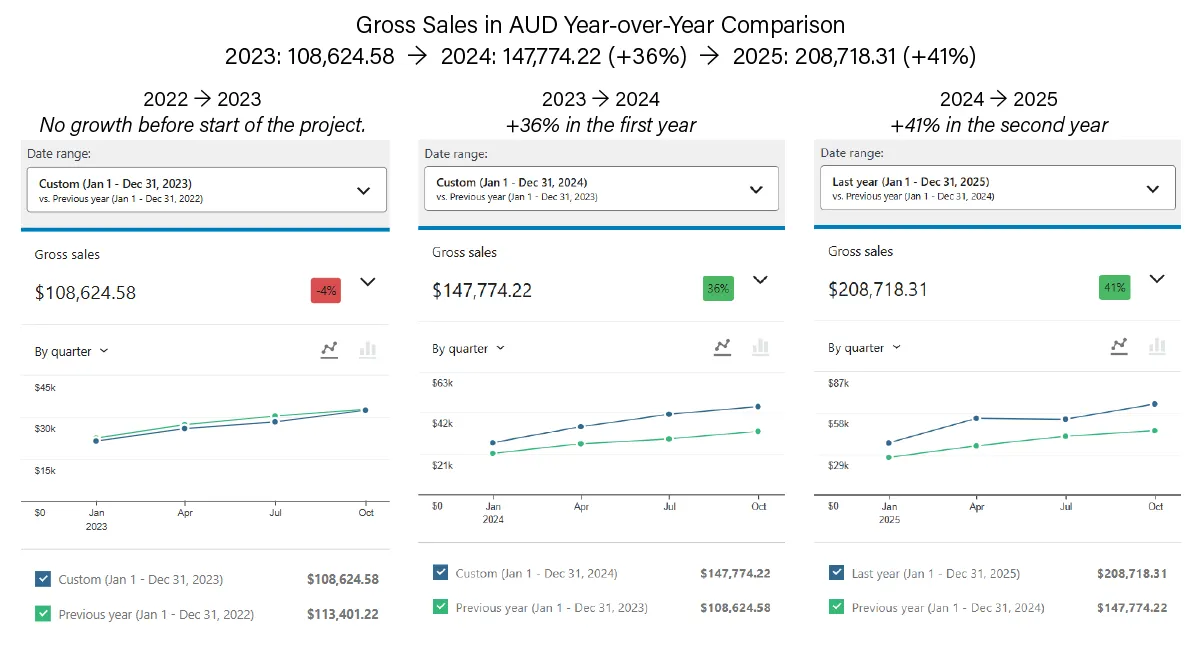
Notably, revenue grew faster than traffic, indicating a significant improvement in traffic quality, improved value per visitor and on-site efficiency (better intent matching, better PDPs, improved checkout).
Conclusion: in this brand's case, channel investments that generated explicit intent (search + targeted ads) and on-site conversion work outperformed awareness-driven placements.
The growth did not come from a single “hack”. It came from:
In short: data-led decision making at every layer of the funnel is what moved the needle.
As of February 2026, year-on-year growth is tracking at 48%, with a projected annual growth rate of 40%+.
With strong foundations in SEO, CRO and retention, the brand is positioned for continued, scalable growth.